Are you a current or former student looking for a letter of recommendation? Please be sure to request one at least 6 weeks before the due date and send me all relevant materials about the program to which you are applying.
If you are a current or former student interested in having me advise your thesis, exam committee, or dissertation, please reach out to schedule time to speak with me in-person.
I am also happy to speak about career opportunities both in academia and outside of academia, particularly in fields such as publishing and foreign policy-related careers.
Please know that I care about your wellbeing and want you to have the academic and emotional support you need to succeed on your academic journey. Feel free to reach out to me with any questions, and take advantage of support groups offered by UM and in Washtenaw County, including NAMI Washtenaw’s Campuses in Color.
Course Descriptions
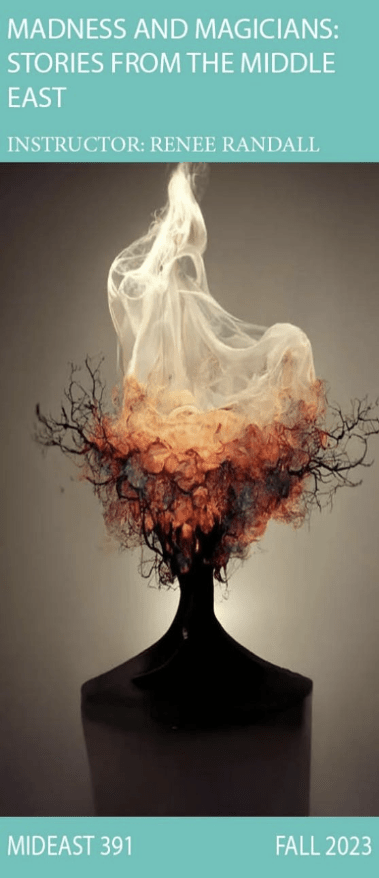
Middle East Studies (MES) 391: This course is all about the ideas and stories that shape aspects of society in the modern Middle East. The ideas and stories in question, of course, have to do with magic and “madness.” In this course, we will explore what both religious and secular texts (including short stories and novels), as well as films and television shows, tell us about the concepts of magic and madness as they influence elements such as gender relations, tensions between religion and psychiatry, experiences of trauma, immigration, and community.
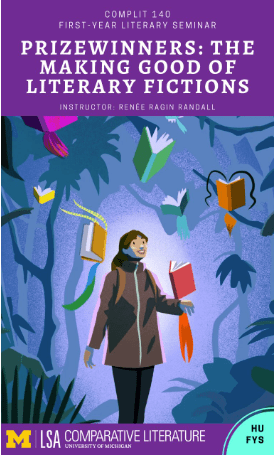
Comparative Literature (CL) 140: In the First Year Seminar, students explore the idea of “good fiction” by evaluating the aesthetic, content, and context-based criteria on which prize committees evaluate submissions and extol their selections. Focusing on various prizes and a noteworthy winner or shortlist-er over the course of the prize’s history (Faulkner and García Márquez for the Nobel, Jabbour Douaihy for the International Prize for Arabic Fiction, etc.), the class embarks on case study-style approaches to investigating the makings of good fiction in the last century and a half of the world literary economy.
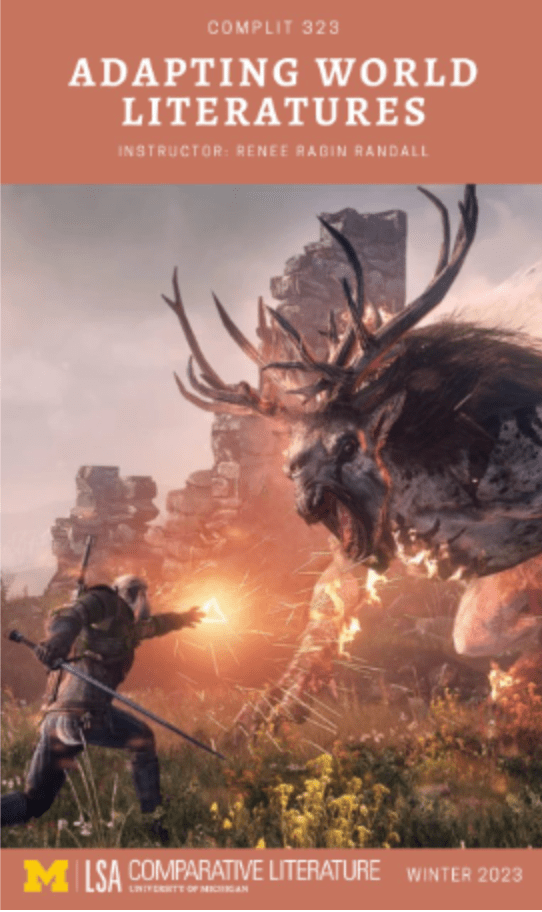
Comparative Literature (CL) 323: This course introduces students to the circulation of world literatures through various forms of adaptation across space and time, genres and media. Students consider how literature is adapted to produce new meanings, explore what makes a “good” adaptation and why, and create their own adaptation of a literary work as a final project.
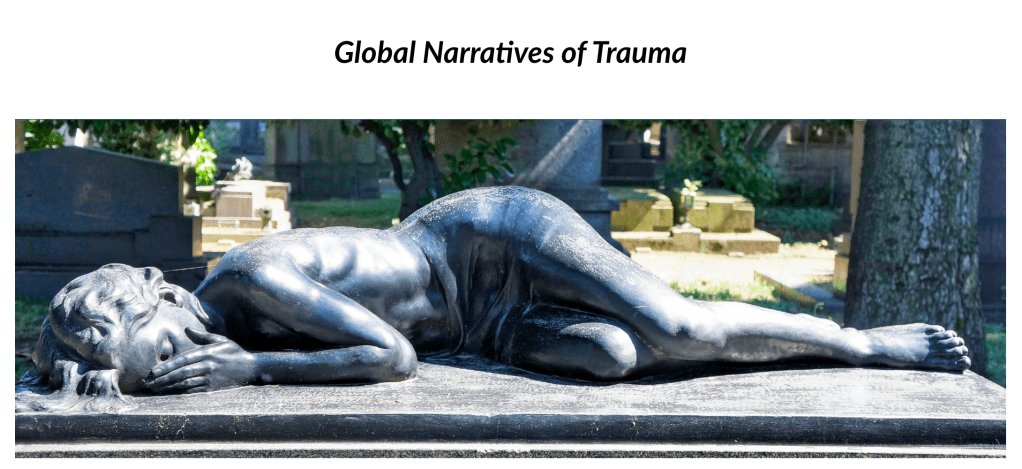
Comparative Literature (CL) 300: This course is interested in how the experience of psychological trauma can be expressed in narrative forms. Students begin by becoming familiar with contemporary Euro- American trauma theory, then study literary texts by authors conversant with both a “western” and a “non-western” way of knowing and describing mind-body-society relationships. Students develop a comparative approach to thinking through trauma, the forces that cause it, its representations and the structures that mediate them.
 Renée Ragin Randall